Comparison · 2 picks
Best Adjustable Dumbbells for a Small Flat (2026)
Affiliate disclosure: we may earn a commission when you buy through links on this page, at no extra cost to you. Our verdicts are our own and are not influenced by compensation. As an Amazon Associate I earn from qualifying purchases.
Adjustable dumbbells are the single best space-saver in a small home gym: one pair replaces a rack of fixed weights and stores in the space of a couple of shoeboxes. The two that dominate the market take opposite approaches to the same problem, so the right pick depends on whether you value speed and feel or durability and room to progress.
The comparison below draws on manufacturer specifications, UK listings and independent reviews. Where an item links to one of our product pages the price updates automatically.
At a glance
All 2 options side by side.
 |  | |
|---|---|---|
| Price | See price | See price |
| Best for | The easiest to live with. | The durable, expandable one. |
| Review | Read review → | Read review → |
| Buy |
The picks in detail
Bowflex SelectTech 552
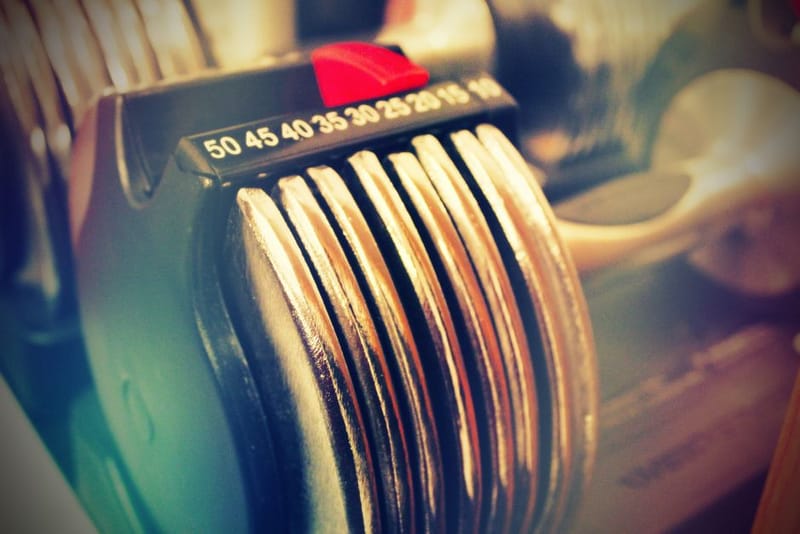
Bottom line. The easiest to live with. A dial on each end swaps between 15 weight settings in a second, and the rounded shape feels closest to a normal dumbbell. It is the most popular pick for a reason, though the plastic tray and dial are less rugged than PowerBlock's cage.
Pros
- Replaces 15 pairs of dumbbells, saving massive amounts of space
- Dial system allows for very quick weight changes
- Highly versatile for full-body strength training
- More cost-effective than buying a full rack of fixed weights
Cons
- Internal mechanisms are delicate; they cannot be dropped
- The footprint is bulky even when using lighter weights
- 24kg max weight may not be enough for advanced lifters
PowerBlock Elite EXP
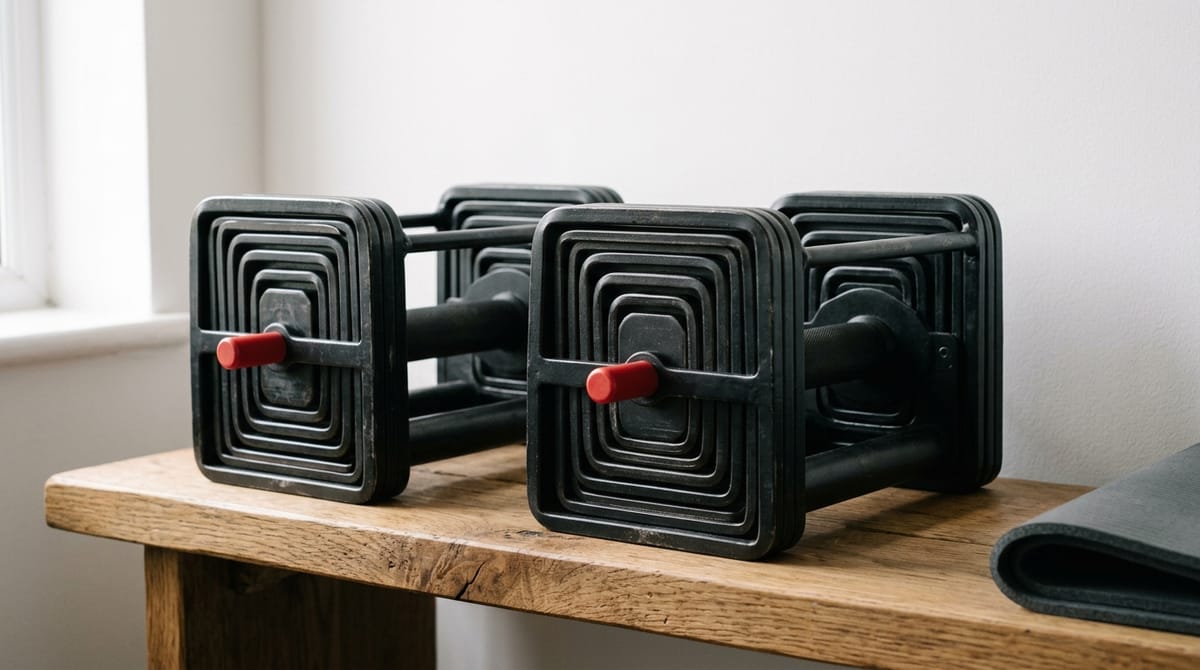
Bottom line. The durable, expandable one. A nested-block cage survives hard use and extends to higher weights with add-on kits, so it grows with your strength. The trade-offs are a boxier feel in the hand and a slightly slower weight change than a dial.
Pros
- Exceptional all-metal core durability
- Expandable to 90 lbs per hand
- Includes 2.5 lb adder weights for micro-adjustments
Cons
- Premium price point
- Cage-style design takes time to get used to
- Slightly slower adjustment than dial models
What weight range do you actually need?
Buyers routinely overestimate this, and it is the most expensive mistake to make, because the top of the range is what you pay for.
For general fitness, the useful figure is not your maximum lift but the weight you can control for eight to twelve repetitions on your weakest movement. That is usually a shoulder press or a lateral raise, and it is a long way below what you can row or press on a bench. A range topping out around 20 to 25 kg per hand covers most people training at home for years.
The case for more is specific rather than general. If you are already lifting heavy and your goal is progressive overload on presses and rows, a ceiling you can reach within a year is a real constraint, and an expandable system earns its premium. If you are buying weights to meet the UK Chief Medical Officers' physical activity guidelines, which recommend muscle-strengthening activity on at least two days a week, the base range of either set is comfortably enough.
The increment matters more than most people expect, too. Jumps that are too large stall progress on smaller muscle groups, which is why sets offering finer steps at the lower end are worth more to a beginner than a high top weight they will not touch.
What should you check before buying for a flat?
Four things that a generic roundup will not raise, and that decide whether a set works in a flat or becomes an expensive annoyance.
Where they live when not in use
Both sets need a clear, stable spot at a height you can reach without stooping. A pair sitting on the floor in a hallway gets kicked; a pair on a shelf you cannot reach safely does not get used. Measure the actual spot before ordering, including the stand or tray if one is included.
The floor underneath
Concentrated weight on floorboards or laminate marks it quickly. A dense mat under the training area protects the floor and dampens noise, and it matters more with adjustable sets than fixed ones because the mechanism dislikes hard contact.
Your ceiling height
Overhead pressing in a flat is often the binding constraint rather than floor space. Stand where you will train, press your arms up with a tape measure, and check before assuming a movement is available to you.
Who is below you
In a shared building this is the practical limit on when you can train, not the equipment. It is worth resolving before you buy rather than discovering it after.
Will your neighbours hear you training?
In a flat this is usually the real constraint, and it is the question generic roundups skip entirely.
Dumbbell work is quieter than most home training, since there is no running belt and no impact from jumping. The noise that travels is the low-frequency thud of weight meeting the floor, and that transmits through a building structure far more readily than airborne sound. A dropped dumbbell is heard downstairs. Controlled lowering is largely not.
Two practical consequences. Set the weights down rather than dropping them, which is better for an adjustable mechanism anyway. And put something dense under the training area: a heavy rubber mat, or a mat over carpet, absorbs far more than a thin foam tile, which compresses and passes the impact straight through.
This also nudges the choice between the two. A set you can lower quietly and set down flat suits a flat better than one you are tempted to drop, which is part of why adjustable dumbbells suit shared buildings better than a barbell and plates.
Dial or block: which should you buy?
Buy the Bowflex SelectTech 552 if you want the smoothest experience: the dial change is genuinely a one-second job, the rounded heads feel natural, and it is the easiest set to recommend to most people training at home. Its weak points are ruggedness and the fixed top weight, so it suits general fitness more than heavy, drop-happy lifting. Buy the PowerBlock Elite EXP if durability and progression matter most - the cage design shrugs off hard use and the expandable range means you will not outgrow it, at the cost of a boxier feel and a slightly slower change.
Whichever you choose, measure the spot they will live. Both are compact, but the tray or stand each sits in still needs a clear, stable place, ideally at a height you can reach without bending awkwardly to swap weights.