Do Massage Guns Actually Help Recovery?
What percussive therapy does to flexibility and soreness, where the trials are too small to lean on, and whether one earns space in a small flat.
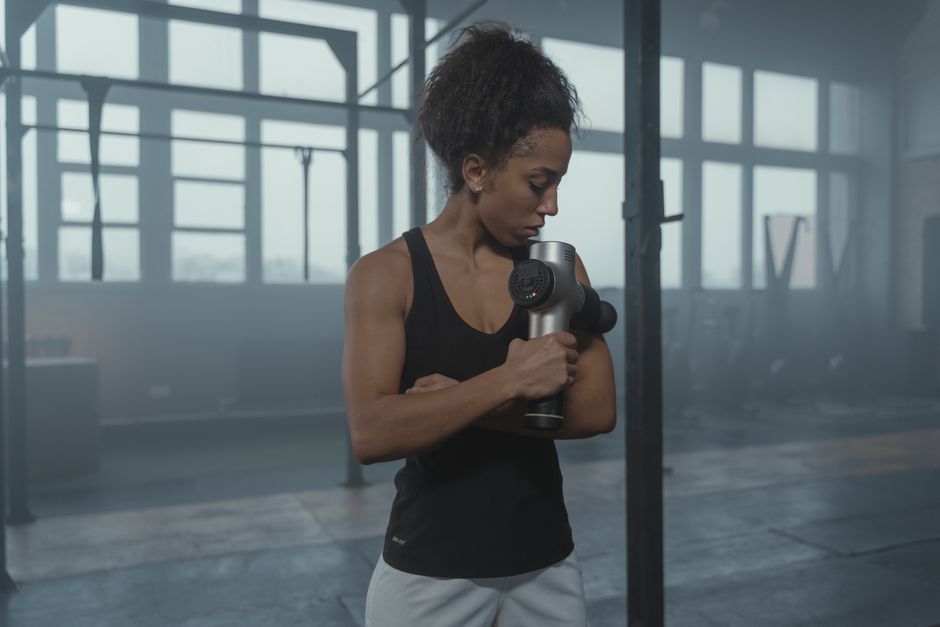
A massage gun is the cheapest, smallest recovery tool you can put in a flat, and that alone makes it worth understanding properly. The research behind percussive therapy is real but narrower than the marketing suggests: the flexibility findings are consistent, the soreness findings are mixed, and almost every trial is small.
This is what the published trials measured, what they found, and where the evidence runs out.
What is percussive therapy?
Percussive therapy (a handheld device that drives a rubber head into muscle at high frequency, usually 30 to 60 times per second) sits somewhere between vibration therapy and deep-tissue massage. The devices in the research literature run at around 53 Hz, which is roughly what a mid-range consumer unit delivers on its middle setting.
The proposed mechanisms are the same ones offered for massage generally: a temporary change in how stretch-sensitive nerve endings respond, increased local blood flow, and a reduction in the perceived intensity of discomfort. Researchers are candid that these are proposals. The authors of the best-known flexibility trial explicitly listed identifying the mechanism, whether mechanical or neurological, as unfinished work.
What does the evidence actually support?
Flexibility. That is the finding that holds up most consistently, and it holds up well.
In a 2020 trial published in the Journal of Sports Science and Medicine, Konrad and colleagues gave 16 men a five-minute percussive treatment on one calf and compared it against sitting still. Ankle dorsiflexion range of motion rose 5.4 degrees, an 18.4% increase, with a large effect size. The control condition moved 1.6 degrees, which was not statistically significant.
The second half of that result matters as much as the first. Maximum voluntary contraction torque was essentially unchanged, moving 0.53 Nm. Static stretching for a comparable flexibility gain tends to cost you some force production in the minutes afterwards. Percussive therapy did not, which is why the authors recommended it as a warm-up tool rather than a recovery one.
A 2023 systematic review in the International Journal of Sports Physical Therapy pooled 13 studies covering 255 adults and found significant flexibility increases at every anatomical site tested: lower body, back and shoulder. On that specific claim, the literature is unusually consistent.
Do massage guns help with muscle soreness?
This is where the picture gets complicated, and where most product marketing overreaches.
The strongest recent test is a 2025 randomised controlled trial in Frontiers in Public Health, available in full on PubMed Central. Thirty physically active men were given a heavy squat protocol to induce DOMS (delayed-onset muscle soreness, the stiffness that peaks a day or two after unfamiliar training), then randomised to static stretching, 25 minutes of percussive therapy, or 40 minutes of it. At 48 hours the 40-minute group reported significantly lower pain scores than the stretching group, along with better knee range of motion and higher jump height.
Read the design before you read the headline. The comparator was static stretching, not resting. The trial cannot tell you whether 40 minutes of percussive therapy beats doing nothing at all, because nobody in it did nothing. Thirty participants split three ways leaves ten per group. And the dose that worked was two 40-minute sessions, which is a substantial commitment for a tool most people use for three minutes in front of the television.
The shorter 25-minute protocol did not produce the same benefits. If there is a real soreness effect here, the evidence suggests it is dose-dependent, and the effective dose is far higher than typical use.
Do they help you perform better?
The most useful study on this question is also the most awkward for the category. In a 2026 trial in the International Journal of Sports Science and Coaching, Driller and colleagues put 59 recreational athletes through a standard dynamic warm-up, then gave half of them 12 minutes of percussive massage on the quads, hamstrings and calves while the others rested.
The massage gun group felt meaningfully more ready to perform. Their measured output did not improve. Countermovement jump height and 20 metre sprint times were no different from the control group, and one measure of explosive jump mechanics, the reactive strength index, was worse in the massage gun group. Perceived muscle soreness was unchanged.
The authors titled the paper "Perceptual gains, performance pains?" for a reason. A tool that makes you feel ready without making you ready is not useless, but it is a different product from the one being advertised, and the gap between the two is worth knowing about before you spend.
Where does the evidence stop?
The 2023 systematic review is unusually frank about the quality of what it pooled, and the limitations apply to nearly everything written about massage guns.
Average methodological quality across the 13 studies scored 5.92 on the PEDro scale, which is fair rather than strong, with individual scores ranging from 2 to 9. Not one study blinded its participants. That is close to unavoidable when the intervention is a loud vibrating device pressed against your leg, but it means every self-reported outcome carries an expectation effect that cannot be separated out.
Only one of the 13 studies followed participants beyond the immediate post-treatment window. Almost everything known about percussive therapy describes the first few minutes after use. And 62.4% of participants were healthy active young adults, with women under-represented throughout, so the findings transfer least well to exactly the people most likely to buy a recovery device for general aches.
The reviewers judged the methods too heterogeneous to combine statistically, which is why there is a systematic review rather than a meta-analysis. Different devices, frequencies, durations and outcome measures across every trial means there is no single pooled effect size to quote.
How would you actually use one?
The evidence points at a narrower use than most owners default to.
The best-supported application is before training, not after. Five minutes on a muscle group improves its range of motion without the force loss static stretching causes, which is genuinely useful if tight ankles or hips limit your squat depth in a small space. Treat it as a mobility tool that happens to feel nice.
For soreness, be realistic about dose. The trial that showed a benefit used 40 minutes. Three minutes on a sore quad is unlikely to replicate it, and there is no evidence it does anything for the underlying muscle damage. What it will reliably do is make the area feel better for a while, which has its own value as long as you are not treating that feeling as a signal you have recovered.
Do not use it as a substitute for training adjustments. Soreness that keeps recurring in the same place is usually telling you something about load progression or technique that a vibrating device will not fix.
Are massage guns safe?
For healthy adults on large muscle groups, the trials report no meaningful adverse events. The devices are used routinely in sports therapy settings.
There are real limits though. The authors of the 2025 DOMS trial flagged a documented case of rhabdomyolysis (a serious breakdown of muscle tissue that releases proteins into the bloodstream) following percussive therapy use in the wider literature. One case report is not a pattern, but it is a reminder that the dose in these trials was applied under supervision, and that longer is not automatically better.
Keep the head off bone, joints, the neck, the lower back over the kidneys, and any area that is bruised, swollen or acutely injured. If you take anticoagulants, have a clotting disorder, varicose veins, osteoporosis or are pregnant, ask a clinician before using one. Pain during use is a stop signal, not something to push through.
Does a massage gun earn its space in a small flat?
On space and price, this is the easiest yes in the recovery category.
A massage gun and its case occupy roughly the footprint of a pair of shoes and live in a drawer or on a shelf. Compare that with the alternative most often marketed alongside it: compression boots need somewhere to store two full-length leg sleeves and a pump, plus floor space and 20 to 30 uninterrupted minutes to use. In a flat where kit lives in the gaps, that difference is decisive.
The honest framing is that a massage gun is a cheap, small, low-commitment purchase whose main well-evidenced benefit is short-term flexibility, with a pleasant subjective effect on top. Judged against that, it is reasonable value. Judged against the claim that it accelerates recovery, the evidence is not there yet. If storage is the binding constraint on your setup, the same logic that governs storing home gym kit in a small flat applies: the tool that stays accessible is the tool that gets used.
How noisy are they in an upstairs flat?
Noise is the one flat-specific problem massage guns do have, and it is airborne rather than structural.
A percussive device produces a continuous mechanical buzz. It does not transmit impact through the floor the way dropped dumbbells or a rowing machine do, so it is not a downstairs-neighbour problem in the way most home cardio is. It is a same-room problem: loud enough to be intrusive over a television and to carry through a thin internal wall late at night.
Practically, that means checking the quoted decibel figure before buying if you share walls, and using the lower speed settings, which are quieter and, on the flexibility evidence, no less effective within the frequency ranges studied.
Frequently asked questions
Do massage guns actually work for recovery?
When should you use a massage gun, before or after exercise?
How long should you use a massage gun on one muscle?
Are massage guns better than foam rolling?
Can a massage gun replace a sports massage?
Is it normal for a massage gun to hurt?
Do Compression Boots Actually Help Recovery?
Quiet Home Cardio for an Upstairs Flat
How to Store Home Gym Kit in a Small Flat