Gym Flooring for a Flat: Protect Floors and Cut Noise
Gym flooring in a flat has two jobs: protecting the floor from dents and stopping impact noise reaching the neighbours. What works, and what doesn't.
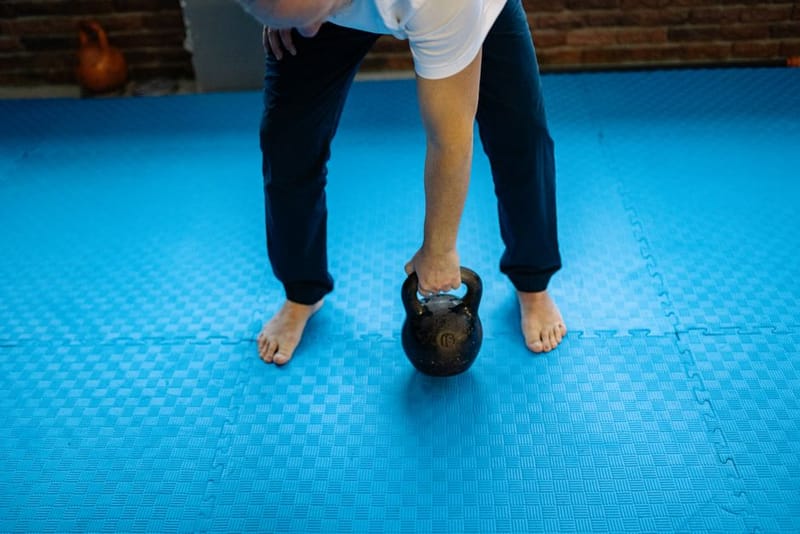
Two different problems get lumped together under gym flooring, and the fix for one is not the fix for the other. A 10mm foam mat will stop a dumbbell scuffing laminate. It will do almost nothing for the neighbour underneath.
What are you actually protecting against?
Three separate risks sit under the same heading, and they need different answers.
Surface damage is the obvious one. A dumbbell set down on its end concentrates its whole weight into a few square centimetres, and laminate, engineered wood and vinyl all dent under that kind of point load. Rack feet, bench feet and treadmill castors do the slower version of the same damage, pressing into the surface over weeks.
Impact noise (sound created when something strikes the floor and travels through the building structure rather than through the air) is the one that causes arguments. A thicker rug and a closed door do not fix it, because the sound is not travelling through the air to get downstairs. It is travelling through the floor itself.
Structural load matters far less often than people fear, but it is worth knowing where the line sits. UK homes are designed around a spread-out imposed load, and a rack or a rower standing on a platform is well inside it. The risk in a domestic flat is almost never the static weight sitting there. It is the dynamic force of something dropped.
How does impact noise travel through a flat?
When a weight hits the floor, the energy has to go somewhere. Some of it becomes airborne sound in your own room. The rest goes into the floor structure as vibration, travels through the joists or the slab, and radiates out of the ceiling below. That is why the neighbour hears a thud you barely register.
What the building is made of changes the outcome more than anything you can buy. A concrete slab is heavy and stiff, so it resists being set moving in the first place. A timber joisted floor, standard in Victorian and Edwardian conversions, is light and springy and passes impact energy on efficiently. Two flats with identical mats can sound completely different downstairs for that reason alone.
Sound insulation between homes is regulated for new build and conversion work in England and Wales under Approved Document E of the Building Regulations, which sets minimum performance for floors separating dwellings. Those standards govern the construction, not what you then do on top of it, and older conversions predate them entirely. That gap is why the same exercise is unremarkable in one flat and a problem in another.
There is a legal backstop worth understanding rather than fearing. Noise from a home can be treated as a statutory nuisance under Part III of the Environmental Protection Act 1990, which a local council can investigate and act on. Ordinary daytime exercise sits a long way from that threshold. Repeated dropped weights at eleven at night is how people arrive at it.
Which flooring material suits which problem?
Materials divide fairly cleanly by density. Light and soft protects surfaces. Heavy and dense controls noise.
EVA foam interlocking tiles
EVA foam (ethylene-vinyl acetate, the light interlocking puzzle-mat material) is cheap, warm underfoot and easy to lift out of the way. It protects a surface from scuffs and light knocks and suits bodyweight work, stretching and yoga. Under real weight it compresses completely and stops absorbing anything, so it contributes very little to impact noise.
Crumb rubber mats and tiles
Crumb rubber (recycled tyre granules bonded into dense mats or tiles) is heavy, and the mass is the point: it absorbs impact energy rather than simply squashing flat. This is the sensible default for dumbbell and kettlebell work in a flat.
Thick vulcanised rubber mats
The stable-mat format is the same material thinking at greater size and weight. It performs well and costs little per square metre, but a single mat is genuinely awkward to carry up a stairwell, and new rubber can smell strongly for a week or two until the room has been aired.
Carpet with a good underlay
An existing carpet and underlay is already a resilient layer, and better for impact noise than any hard floor you might install instead. Its weakness is stability: a bench or rack standing on soft carpet rocks slightly, and castors sink in.
A plywood platform over rubber
A sheet of plywood laid on top of rubber spreads a concentrated load across a wide area and gives a rigid, level surface to work on. For racks, benches and heavier lifting this beats buying a thicker mat, because it changes how the load reaches the floor rather than just cushioning it.

How thick does gym flooring need to be?
Thickness only helps while the material still has room left to compress. Once a mat bottoms out under a load, the extra millimetres do nothing, which is why a heavy dumbbell on thick foam lands with almost the same sound as on a bare floor. Density decides where that limit sits, so the useful question is not how thick the mat is but what it is made of.
A rough guide by activity, assuming dense rubber rather than foam:
Thickness by activity
- Bodyweight, yoga, stretching
- 6-10mm of almost any mat
- Dumbbells and kettlebells, set down under control
- 15mm dense rubber
- Benches, racks, heavier dumbbells
- 15mm rubber plus a plywood platform
- Barbell work with any chance of a drop
- No domestic build reliably solves this above a neighbour
The last row is the honest one. A dropped barbell delivers a large force in a few milliseconds, and no flooring sold for home use converts that into something the person underneath will not hear. If barbell work matters to you and you live above someone, the realistic choices are lighter loads lowered under control, or a gym membership for the heavy sessions.
The same logic applies to cardio kit, where the noise is continuous rather than sudden. Our guide to quiet home cardio for an upstairs flat covers which machines start quiet, and the rowing machine in a flat guide goes through the noise, storage and floor issues specific to rowers.
Where should you put the gym in the room?
Position changes impact noise more than most people expect, and it costs nothing at all.
A timber floor deflects most in the middle of its span, midway between the walls the joists rest on. Working close to a supporting wall puts the load where the floor is stiffest, so less energy goes into moving the structure and less arrives downstairs. If you can work out which way the joists run, laying a platform across them rather than along a single joist spreads the load further again.
Time of day does more work than any mat. The same set at eight in the evening and at eleven at night are different events for the person below, regardless of what is under your feet.
Corners earn their place for a second reason: in a small room a corner is often the only spot where a bench or rack can stay put without blocking a route through. Our guide to fitting a home gym in a small corner covers the layout side of that.
What can you do if you rent?
Renting rules out permanent work, which matters less than it sounds, because nearly everything effective here is loose-laid anyway.
Rubber tiles, mats and plywood platforms all sit on the floor without adhesive and lift out on the day you leave. Read the tenancy agreement or lease before covering a floor long-term: many leases on flats require a proportion of the floor area to stay carpeted precisely to control impact noise, and that clause binds the leaseholder whether they live there or let the flat out.
Two practical cautions. Dense rubber over underfloor heating traps heat, so check the heating system's own guidance before covering a large area with it. And any mat left in place for months can mark the floor underneath, either by holding moisture against it or through dye transfer from cheap rubber, so lifting mats occasionally to let the floor breathe avoids both.
Talking to the neighbour below before you start is the cheapest noise control available. Most complaints are about surprise and repetition rather than volume.

Quiet Home Cardio for an Upstairs Flat

Rowing Machine in a Flat: Noise, Storage & Floors
How to Store Home Gym Kit in a Small Flat