Under-Desk Treadmill vs Walking Pad: Which to Buy?
Walking pad or under-desk treadmill? The difference comes down to space, speed and whether you'll ever jog. Here's how to choose for a small UK home.
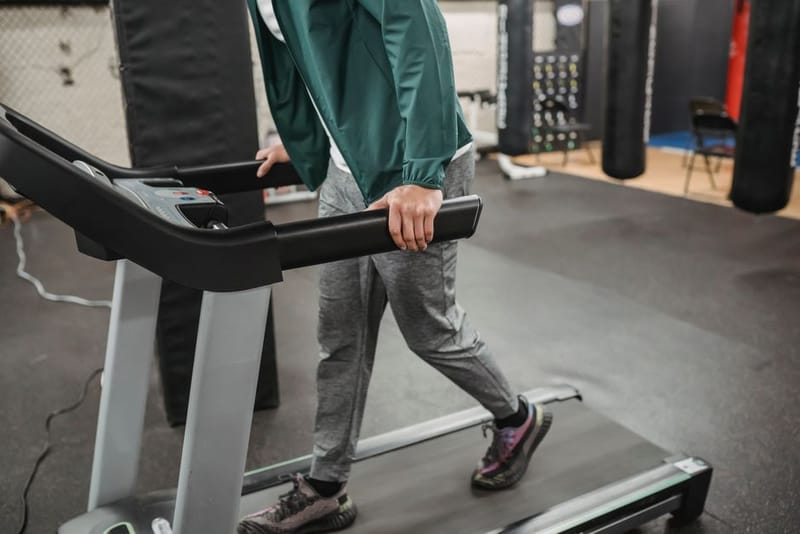
The two get lumped together, but a walking pad and an under-desk treadmill solve slightly different problems. If your priority is fitting steps into a small UK home without giving up floor space, the difference between them decides which one you should actually buy. This guide breaks down the trade-offs on space, speed and use, drawing on how a treadmill works and where the slimmed-down versions cut corners.
What is the difference between a walking pad and an under-desk treadmill?
A walking pad is the stripped-back option: a low, flat running belt with no upright console and either no handrail or a small removable one. It is designed to tuck under a standing desk, and most fold flat or in half to slide out of sight. Top speeds are typically capped around 6 km/h - a brisk walk, not a run.
An under-desk treadmill overlaps but keeps more of a real treadmill's features. Many are '2-in-1' designs with a handrail that folds down for under-desk walking and raises up for jogging, a higher top speed, sometimes a small incline, and a more substantial motor and frame. You gain the ability to run; you pay for it in size, weight and price.
| Walking padsSlim, fold-flat, walking only | Under-desk treadmillsSlimline treadmill with a raise-up rail | |
|---|---|---|
| Top speed | Around 6 km/h | Commonly 10 to 12 km/h |
| Incline | None on most models | Sometimes, usually fixed or manual |
| Handrail | None | Yes - folds up for jogging |
| Folded footprint | Slides under a bed or sofa | Folds flat but is longer and heavier |
| Fits under a standing desk | Yes - nothing sits above deck height | Only with the rail folded down - check the clearance |
| Typical weight limit | 100 to 120 kg | 110 to 130 kg |
| Best for | Steps while you work, in the smallest spaces | Walking at the desk plus occasional light jogging |
How much space does each need?
This is usually the deciding factor in a small home. Walking pads are the slimmer of the two: many are only 10-14 cm tall when folded, so they slide under a bed, sofa or wardrobe and disappear between sessions. That stow-away ability is the whole point.
Under-desk treadmills, especially 2-in-1 models with a raised handrail, fold up rather than flat, so they still need a corner or a gap beside furniture to lean against. They are heavier to move, too. If your storage is genuinely a slot under the sofa, a walking pad wins; if you have a corner to spare, an under-desk treadmill is workable.
Will it actually fit under your desk?
This is the question that catches people out, and it is not answered by the machine's floor footprint. What matters is the height of everything above the belt.
A walking pad has nothing above deck height, so it slides under any desk you can stand at comfortably. An under-desk treadmill has a handrail, and even folded down it adds height at the front. If your desk is a fixed-height one you already stand at, measure the clearance from the floor to the underside of the desk and compare it against the machine's folded height, not its deck height - manufacturers quote both and it is easy to read the wrong one.
The second constraint is stride length. A longer belt suits taller users, and it is the dimension people trade away first when buying for a tight space. If you are over about 6 ft, check the belt length before the footprint.
How much speed and incline do you actually need?
A walking pad does one thing well: steady walking while you work, take calls or watch something. There is no incline and no real running, and that simplicity is a feature, not a flaw, if walking is all you want.
An under-desk treadmill stretches to light jogging and sometimes a modest incline, which makes it a closer substitute for a gym treadmill in a flat. If you want your one piece of cardio kit to cover both desk-walking days and the occasional run, the treadmill earns its extra footprint. If you already run outdoors and just want to move more during the working day, the walking pad is the smarter buy.
How do they compare on noise, weight limit and build?
Walking pads tend to be quieter and lighter, which suits flats and shared walls, but they usually carry a lower user weight limit and a smaller motor, reflecting their walk-only design. Under-desk treadmills generally offer a higher weight limit and sturdier build, at the cost of more noise and mass. If you are a heavier user, or you will run rather than walk, check the weight limit and motor rating closely - it is the spec most often overlooked, and the one that most affects how long the machine lasts.
In a flat the noise that matters is not the motor - it is the impact travelling through the floor to whoever lives below. Both machines transmit it, and the deck's cushioning does more to reduce it than the price does. If you are on an upper floor, a mat underneath is worth more than a quieter motor, and our guide to quiet home cardio for an upstairs flat goes into what actually helps.
Which should you buy?
Buy a walking pad if your space is tight, you want it to vanish under furniture, and steady walking while you work is the goal. Buy an under-desk treadmill (ideally a 2-in-1 with a lifting handrail) if you have a corner to store it, want the option to jog, or need a higher weight limit. For most people in a genuinely small home who mainly want to add daily steps, the walking pad is the more honest fit; the treadmill is for when one machine has to do double duty.
Frequently asked questions
What Is a Walking Pad? A UK Guide for Small Homes
Walking Pad Weight Limits Explained
Can You Use a Walking Pad on Carpet?
Best Walking Pad for a Low Ceiling
Can you run on a walking pad?
Which is better for a small flat?
Do walking pads and under-desk treadmills need a special floor or mat?
Is a walking pad enough exercise on its own?
Is a walking pad the same as an under-desk treadmill?
Which is better for a home office, a walking pad or an under-desk treadmill?
Find the right compact cardio for your space
See our walking pad and compact cardio guides, sized for small UK homes.